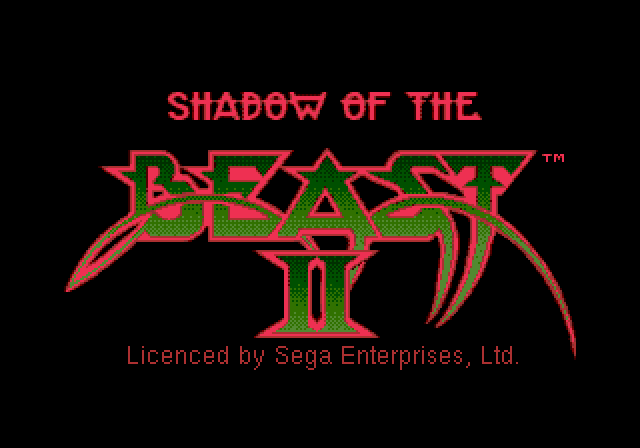
Under the microscope: Shadow of the Beast II

Shadow of the Beast II was published for Amiga in 1990. A Genesis adaptation was released in 1992, and an enhanced Sega CD version appeared in 1994. In this edition, the two Sega ports go under the microscope.

Beast II is notoriously difficult. Here’s how it was described in GamePro:

This game’s challenge is hairy… Normal Mode is abnormally hard, and Ridiculous Mode is no laughing matter. Even Easy Mode will make intermediate players cry for their mommas.

Its predecessor, Shadow of the Beast, was similarly vexing. But it at least had an unlimited health cheat. Here’s how one GameFAQs guide (from user hellobatman) described it:

Play the game and get a high score… Enter your name as ZQX. Back at the title screen, hold A, B and C together and press Start. Now you are invincible! You will lose health but when you reach 0 you will just loop back around to 11.

I must say, there’s no shame in using the cheat. This game is so hard that crazy burnt out Vietnam veterans forget about their war experience and start having Beast flashbacks.

Is there anything similar in Beast II? Let’s check…


The Genesis version

The first thing I do when examining a new game is to identify the first few places where it checks for player input. For Beast II on Genesis, the first real check of the controller buttons is on the Psygnosis Presents screen:

; Check whether the Start button's bit is set. 
btst.b #0x7,(0x1dd6,A6)
; If it is, bail out.
bne.b exit
; Otherwise, decrement the timer and loop again.
dbf D7w,wait_for_start_000682e4

This is just checking for the Start button, so it’s not anything cheat-related.

The second check is more interesting, however – it’s looking for A+B+C+Start.

; Load the input value
move.b (0x1dd6,A6),D0b
; Check whether it matches 0xf0
cmpi.b #0xf0,D0b

But this check is already known – pressing those buttons on the Psygnosis screen displays the staff credits.

The next checks are even more interesting. Just as the Psygnosis screen fades out, it looks to see whether A+C+Up+Start is being held. If it is, the value at memory address 00ff2279 gets updated.

; Load the input value
move.b (0x1dd6,A6),D0b
; Check whether it matches 0xe1
cmpi.b #0xe1,D0b
; Store the result
st (0x1e49,A6)

Then, at the title screen, we have a check for the button combination Down+B+Start. If those buttons are being held, a different memory address gets updated – but only if the one from above is nonzero.

; Load the input value
move.b (0x1dd6,A6)
; Check whether it matches 0x92
cmpi.b #0x92,D0b
; Bail out if not
bne.b 0x000682c8
; Check the whether the A+C+Up+Start effect is set
tst.b (0x1e49,A6)
; Bail out if not
beq.b 0x000682c8
; Store the result
move.b #0x1,(0x1df8,A6)

Putting those things together, you should:

  1. Start the game.
  2. Dismiss the Psygnosis logo by holding A+C+Up and pressing Start.
  3. At the title screen, hold Down+B and press Start.

If you got everything right, you’ll have unlimited health – enemy attacks won’t drain your health meter at all.

Intermediate players rejoice! You can now proceed without tears.


The Sega CD version

Now that Genesis players can cheat shamelessly, we can turn our attention to the Sega CD version of Beast II.

The input checks on this version’s logo screens weren’t remarkable. But there’s some notable code that runs on the Options screen. Here’s a translation of its logic into pseudo-Python.

# Check the just-pressed button against a static sequence
if pressed_button_0915 == sequence_00229494[index_20]:
    # If there was a match, increment the check position in the sequence.
    index_20 += 1
    if index_20 == 30:
        # If there were 30 matches, record the fact.
        effect_090e = 0x46554232
        ...
else:
    # If there wasn't a match, reset the sequence check position.
    index_20 = 0

This is a run-of-the-mill cheat sequence detector. It’s looking for 30 correct button presses in a row.

The 30 buttons are:

Start, Up, Down, Left, Right,
Down, Up, Right, Left, Start,
Up (x4), Start (x1),
Down (x3), Start (x2),
Left (x2), Start (x3),
Right (x1), Start (x4)

Get them all right, and the screen border will turn from black to red.

And, as you might suspect, you’ll have unlimited health when playing the game.

You can now enjoy the Sega CD version’s enhanced music without it being interrupted by Game Over screens.


Outro

When you finish entering the cheat code in the Sega CD version, the value 0x46554232 gets stored in memory. If those bytes interpreted as ASCII characters, they represent the string FUB2. F— you, Beast II? We may never know.

This is my first foray into Sega CD reverse engineering – I hope there are more secrets lurking in games for that system. If you have any suggestions for where to look, leave a comment!

SONIC WEEKLY: Assorted Bits

It’s Season 6, Episode 7 and we’re joined by a very special guest on the show — you, the listener! Together we sort through various Sonic news items, a 16-bit bite of Rings of Saturn, and which Sonic game we’d like to speedrun.

SEGA Talk #192: Super Monkey Ball 2

On this SEGA Talk, we roll back into the world of Super Monkey Ball with a look at the Gamecube exclusive sequel! How did the series expand on the characters and their world? What additions did the development team make to the gameplay? And what role does the game play in undergoing surgery? Sharpen your scalpels and find out on SEGA Talk!

[iTunes – Stitcher – Download]

Support us on Patreon! Get early access, have your memories read on the show, select the games we talk about!

Under the microscope: Beavis and Butt-head

In this edition, we’re examining Beavis and Butt-head, the 1994 adaptation of the MTV series for Genesis by Radical Entertainment.

Data miners have looked through this game and found various unused elements – text, animations, music. They’ve compared the visuals in prerelease screenshots to the final game. They’ve noted the title’s unusual use of the Genesis sound hardware. But I think they missed something – a hidden cheat code.

Details are below…

SEGA Talk #191: Yakuza 4 (2010)

What’s better than one legend in Kamurocho? How about FOUR?! Today on SEGA Talk, we’re cracking open Yakuza 4—4 protagonists, 4 fighting styles, and 4 times the drama! Don’t 4-get to settle in, because we’re diving right in!

[iTunes – Stitcher – YouTube – Download]

Support us on Patreon! Get early access, have your memories read on the show, select the games we talk about!

SEGAbits Presents Arcade Adventure 5: Arcade meetup at Galloping Ghost Arcade in Brookfield, IL on October 3, 2026

MEETUP HOURS: 1pm to 5pm
Pre-event meetup from 12pm to 1pm at Imperial Oak Brewing

Hop into your fastest vehicle and hit the track, because all roads lead to SEGAbits Presents Arcade Adventure 5! Meet up with fellow SEGA fans at Galloping Ghost Arcade in Brookfield, Illinois on October 3rd, 2026 to play hundreds of arcade games in the world’s largest arcade!

Under the microscope: The Magic School Bus

My perception in the 90s was that the Sega Genesis was supposed to be your older brother’s console. It didn’t matter whether you had an older brother, or were an older brother; Sega’s marketing always implied that Genesis was just slightly cooler than you were.

Sega did try to appeal to younger siblings, however. The company’s Sega Club imprint published several titles for little kids, some of which purported to be at least slightly educational.

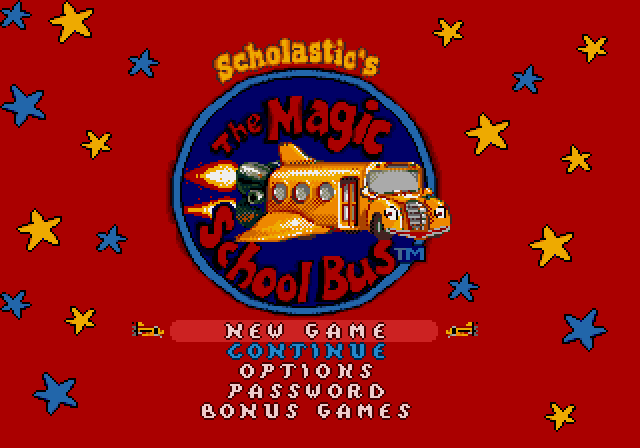
Scholastic’s The Magic School Bus: Space Exploration Game was one of these Sega Club games. It’s a collection of mini-games focused on space, and is inspired by the 1990 book The Magic School Bus Lost in the Solar System.

Why examine a 30 year old edutainment game? It caught my eye because (a) I had the original The Magic School Bus space book when I was a kid, and my parents would never read it to me because it was too long; and (b) it was developed by Novotrade, and I’ve found interesting things in a few Novotrade games in recent years.

Below are details on how this game’s password system works, and notes on how to use a previously-unpublished cheat code to bypass it altogether.

Under the Microscope: Stimpy’s Invention

Some game cartridges from the 16-bit era shipped with backup chips. These allowed players save their progress. But they were expensive relative to a software-only alternative, session passwords.

In addition to being cheaper, session passwords could be shared. Players eagerly subscribed to game magazines that printed them. And in the 90s, having a notebook full of Sega Genesis codes was a good way to increase your status on the playground.

Hands-On Preview: Sonic the Hedgehog Pinball by Jersey Jack Pinball

Can you believe that despite being a video game icon for 35 years, the Sonic the Hedgehog series has never had a full size pinball machine? SEGA actually came close. In 1994, SEGA purchased Data East Pinball Inc. and established SEGA Pinball, which was subsequently sold in 1999 to become Stern Pinball. However, even with SEGA being in the pinball industry at the peak of Sonic’s popularity, they never once thought to release a Sonic pinball machine. Fast forward to 2026, the year of Sonic’s 35th anniversary, and thanks to Chicagoland-based Jersey Jack Pinball it has finally happened! Sonic has a pinball machine.

SEGA Talk #190: Kid Chameleon (1992)

Smash your head into a Prize Block because on this episode of SEGA Talk we’re transforming into Kid Chameleon! How did this ambitious platformer come to be? Which teen heartthrob did they base the hero on? And what legacy – if any – did this game leave behind? Find out on this transformative episode of SEGA Talk!

[iTunes – Stitcher – YouTube – Download]

Support us on Patreon! Get early access, have your memories read on the show, select the games we talk about!

SEGA Talk #189: Judgment (2018)

Put on your detective badge, step into the neon-lit streets of Kamurocho, and get ready to trade your heat actions for courtroom objections as we dive into the boldest spin-off Ryu Ga Gotoku Studio has ever produced: Judgment. This isn’t just “Yakuza with a lawyer.” This is a game that traded Kazuma Kiryu for Takuya Kimura, swapped organized crime for legal suspense, and asked whether the Dragon Engine could tell a whole new kind of story. Find out on this episode of SEGA TALK!

[iTunes – Stitcher – YouTube – Download]

Support us on Patreon! Get early access, have your memories read on the show, select the games we talk about!

SEGA Announces Gamescom 2026 Line-Up

SEGA is heading to Gamescom 2026 in a big way, giving attendees the chance to go hands-on with some of its biggest upcoming releases. From August 26–30, fans visiting Hall 7 at Cologne’s Koelnmesse can experience an immersive SEGA booth packed with playable demos, themed photo opportunities, on-stage challenges, and exclusive merchandise giveaways. Five upcoming titles will be featured, each with its own dedicated booth area designed to showcase the game in a unique and memorable way.

SEGA Talk #188: Virtua Fighter 2 (1994)

On this SEGA Talk we return to the world of Virtua Fighter with a look back at the second game in the series! What did Virtua Fighter 2 do to improve on the winning formula of the first game? How did it expand on the characters and lore of the Virtua Fighter world? What is the best modern way to play the game? Knuckle up and find out on SEGA Talk!

[iTunes – Stitcher – YouTube – Download]

Support us on Patreon! Get early access, have your memories read on the show, select the games we talk about!