Under the microscope: Stormlord

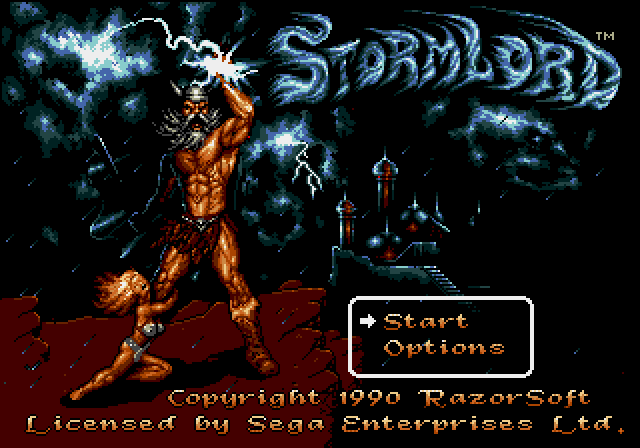
Stormlord was originally published for the ZX Spectrum and other 8-bit PCs by Hewson Consultants in 1989. A Genesis version, produced by RazorSoft and Punk Development, followed in 1991.

The console version of Stormlord is noticeably different from its PC counterparts in one striking way: there’s no nudity. In the game, you play as the Viking hero StormLord, rescuing fairy princesses from a dastardly antagonist. StormLord doesn’t wear much clothing, but the fairy princesses are entirely naked in the original artwork. In the Genesis edition, they’re covered up (albeit minimally).

In an excellent interview from 2019 in Gaming Alexandria, Genesis version programmer Kevin Seghetti said this about the game:

[We] did put a cheat code system in the game, so that we could release codes after the game came out (a method to keep getting your game mentioned in the magazines of the time). One of the codes removes the clothes from the fairies, revealing the original artwork. Razorsoft specified this as well. I vaguely recall we may have removed that particular cheat code before we shipped.

Did they actually remove this cheat code? No – it remained in the retail cartridge. I found it in the game data, along with another cheat code that managed to stay secret for the last 35 years. Details on these new codes and how they work are below!

Under the microscope: Shaq Fu

Shaq Fu, the 1994 Genesis game from Delphine Software, lets players experience the dream of the 1990s: to become basketball legend Shaquille O’Neal as he battles an evil mummy from an alternate dimension.That’s right: Shaq Fu is a 2D fighting game, not a basketball game. I approve – it’s great when pop culture figures star in unexpected genre games. Should the Wu-Tang Clan be in a tournament fighting game? Absolutely. Should Aerosmith be in a light gun game? Definitely. I only regret that there was never a Seinfeld-themed beat-’em-up.

I found a previously-unpublished cheat code for this game. You can use it to speed Shaq’s progress through the Second World and get him back to the First World in time to play in the big charity game. Details are below!

Under the microscope: FIFA Soccer 96

We talk sometimes about how cheat sites like GameFAQs have quality control issues. Lots of games have bogus codes listed. Some are incorrectly transcribed, some are actually for other games, and some are totally made up.

Some of the codes for the Genesis version of FIFA Soccer 96 are bogus. Neither of these work, for example:

EA Dream Team: Press A(2), B(2), C(2), B, C(2), A(2) at the options screen.

Super Power: Press B, A, B(2), C, B, A, C, B(4) at the options screen.

What species of bogus are they? It turns out they’re incorrectly transcribed. As we’ll see below, they’re close to right – but not quite.

While I was looking into this, I found several other cheat codes for this game that I don’t think have been documented before. Furthermore, I found nearly identical codes for FIFA 97: Gold Edition. Read on for details!

Under the microscope: Beavis and Butt-head

In this edition, we’re examining Beavis and Butt-head, the 1994 adaptation of the MTV series for Genesis by Radical Entertainment.

Data miners have looked through this game and found various unused elements – text, animations, music. They’ve compared the visuals in prerelease screenshots to the final game. They’ve noted the title’s unusual use of the Genesis sound hardware. But I think they missed something – a hidden cheat code.

Details are below…

Under the microscope: The Magic School Bus

My perception in the 90s was that the Sega Genesis was supposed to be your older brother’s console. It didn’t matter whether you had an older brother, or were an older brother; Sega’s marketing always implied that Genesis was just slightly cooler than you were.

Sega did try to appeal to younger siblings, however. The company’s Sega Club imprint published several titles for little kids, some of which purported to be at least slightly educational.

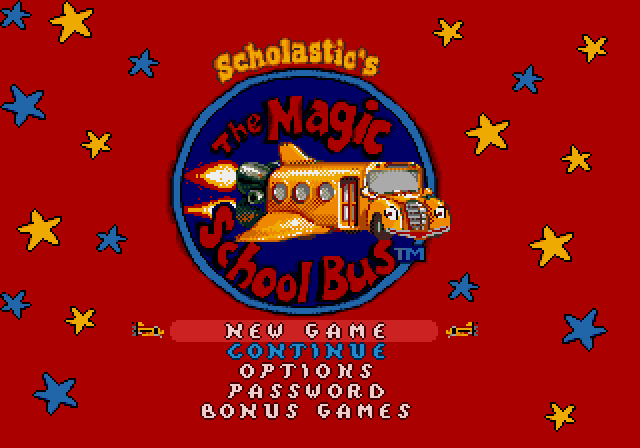
Scholastic’s The Magic School Bus: Space Exploration Game was one of these Sega Club games. It’s a collection of mini-games focused on space, and is inspired by the 1990 book The Magic School Bus Lost in the Solar System.

Why examine a 30 year old edutainment game? It caught my eye because (a) I had the original The Magic School Bus space book when I was a kid, and my parents would never read it to me because it was too long; and (b) it was developed by Novotrade, and I’ve found interesting things in a few Novotrade games in recent years.

Below are details on how this game’s password system works, and notes on how to use a previously-unpublished cheat code to bypass it altogether.

Under the Microscope: Stimpy’s Invention

Some game cartridges from the 16-bit era shipped with backup chips. These allowed players save their progress. But they were expensive relative to a software-only alternative, session passwords.

In addition to being cheaper, session passwords could be shared. Players eagerly subscribed to game magazines that printed them. And in the 90s, having a notebook full of Sega Genesis codes was a good way to increase your status on the playground.