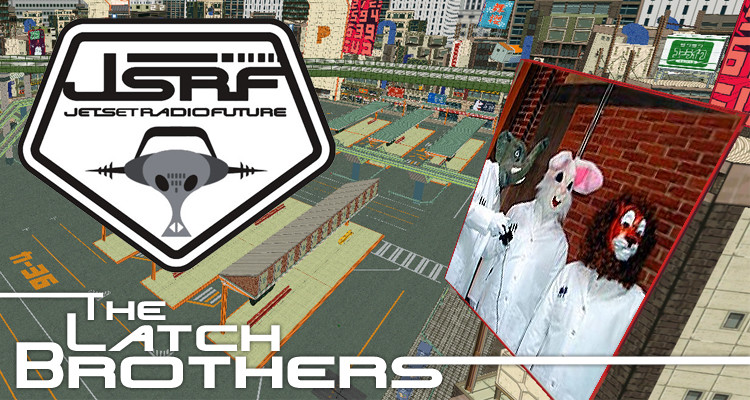
Jet Set Radio and its sequel Jet Set Radio Future are often cited as having some of the best music to come from SEGA thanks in a large part to Hideki Naganuma and Richard Jacques. While in-house talent played a large role in creating such memorable soundtracks, the soundtracks also consisted of licensed music from artists that included Guitar Vader, Cibo Matto, Deavid Soul and others. This week on SEGA Tunes (the feature formerly known as Tuesday Tunes) we’re focusing on a third type of Jet Set Radio music contributor: The Latch Brothers.
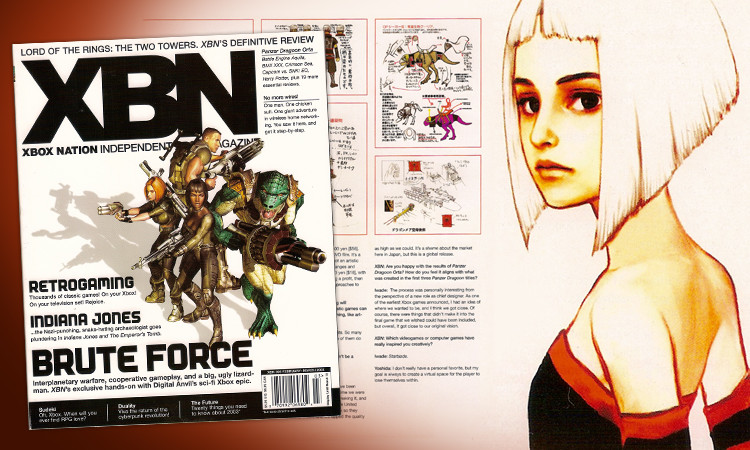
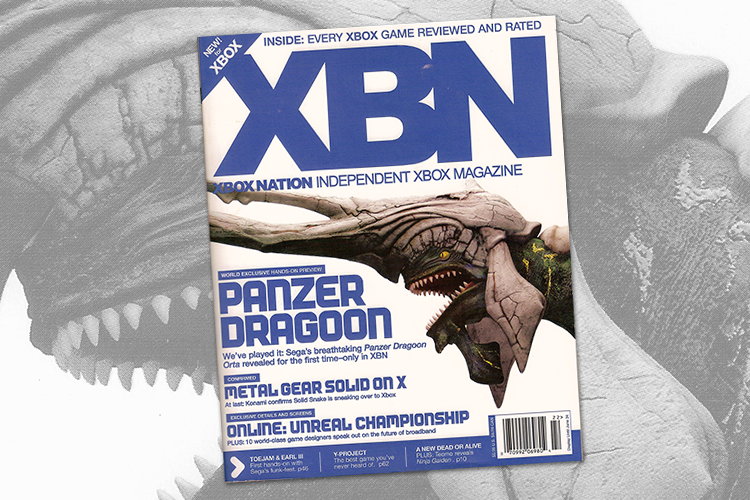
As evidenced last month, the unofficial Microsoft Xbox magazine Xbox Nation (XBN) really liked Smilebit. Their premiere issue featured Smilebit’s Jet Set Radio Future, which is surprising given Halo‘s dominance at the time, and their third issue featured a Panzer Dragoon Orta cover and an eight page preview and interview with former Team Andromeda staff. As the magazine continued, XBN kept up on various SEGA and Smilebit titles. In the magazine’s sixth issue they returned to Japan for another Smilebit interview, this time with Panzer Dragoon Orta artists Takashi Iwade and Kentaro Yoshida. Let’s crack open this issue to see what these legends had to say!
Unless you’re a Sonic The Hedgehog fan, collecting merchandise from SEGA franchises can be a difficult venture. Some games simply have little to no merchandise. Bug!, for example, only has a windup figure from SEGA’s Jack in the Box kid’s meal and a few Saturn era promotional pieces. Ecco the Dolphin and Toejam and Earl merchandise is almost non-existent; the former also had a Jack in the Box kid’s meal toy and the latter is just now getting products thanks to the recently funded Kickstarter campaign. Japanese franchises, like Phantasy Star Online, have quite a lot of collectibles but much of it is Japan only and requires importing and ebay hunting. Other franchises, like Shenmue, have had quite a bit of merchandise in the past and in recent years, but good luck finding any of it for a low price point.
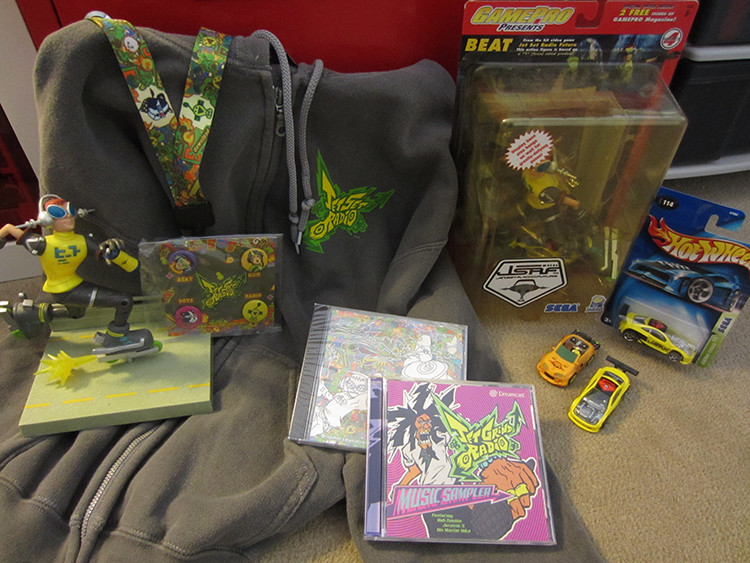
Jet Set Radio, meanwhile, has quite a bit to offer fans when it comes to collectibles with several items releasing outside of Japan and many of them being surprisingly affordable. Seeing as Jet Set Radio is one of my favorite franchises, I’ve amassed a small collection over the years which I wanted to show off both because I am incredibly conceited and because I thought it would serve as a nice guide for those wondering what sort of Jet Set Radio merchandise is out there.
Jet Set Radio had a bit of an identity crisis when it reached the West. When the game was first revealed in Japan, few media outlets knew exactly what to make of the game. Was it rhythm game? Was it a Japanese take on Tony Hawk Pro Skater? From the teases we got, it appeared to be a bit of both. The first real concrete explanation of the game came from America’s Official Dreamcast Magazine, which featured an in-depth interview with Smilebit and a preview of the game. While ODCM did a fantastic job with explaining the game and selling many Dreamcast owners on it, myself included, SEGA of America did a less than fantastic job of letting the general public know what the game was all about.
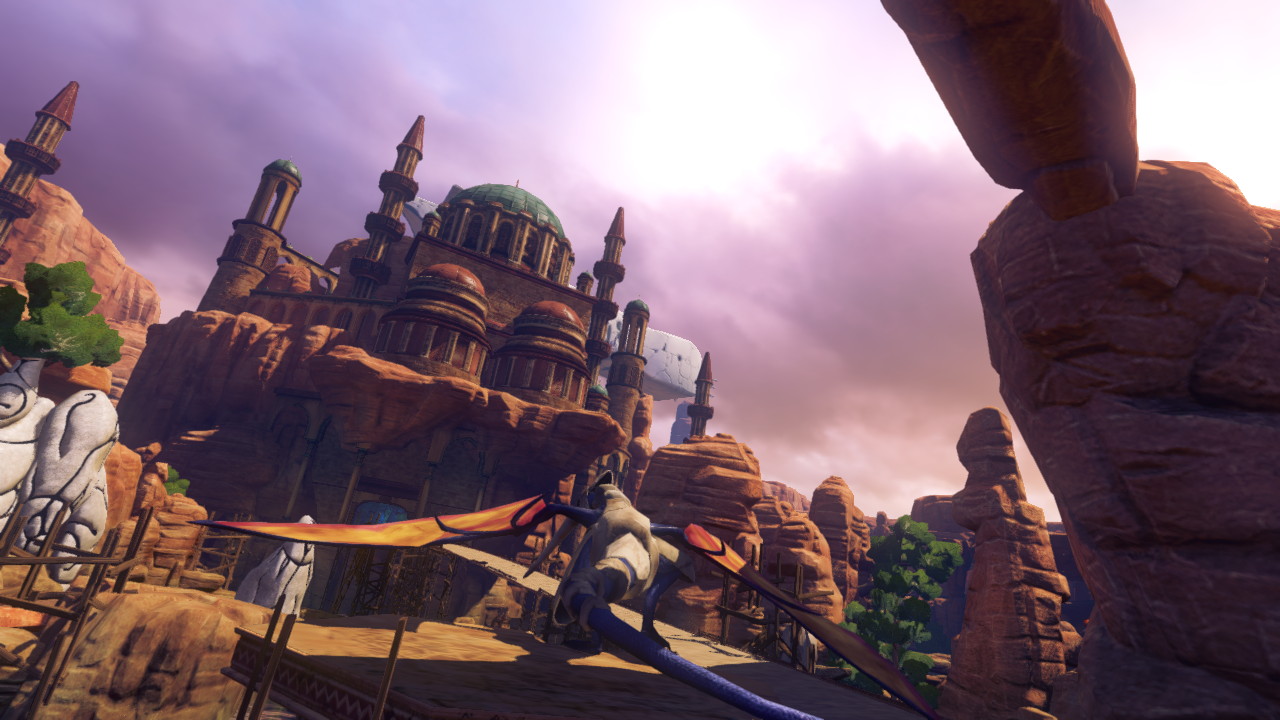
The announcement of Sonic & All-Stars Racing Transformed is one of the more memorable moments here at SEGAbits, as it was the first major game reveal press event SEGA invited us to. Weeks before the game was officially announced to the public, we received an invite to a secret event that – while it didn’t name the game – was all but confirmed to be a Sonic & SEGA All-Stars Racing sequel thanks to the design and description of the event. Taking place at an indoor go-kart track in California, our writers attended and were floored when the game was revealed. The first thing that caught our eye: Panzer Dragoon was back with an impressive track named Dragon Canyon!
When SEGA announced that they were discontinuing the Dreamcast in 2001, like many SEGA fans I was in a daze. What competitor console would I buy to continue to enjoy SEGA games? How could I keep up on SEGA news with the cancellation of the fantastic Official SEGA Dreamcast Magazine? With the knowledge that certain internal development teams would be shifting focus to specific consoles, fans had to decide if they were to become a Sony, Microsoft, or Nintendo owner (or all three if you were one of those spoiled kids). As a fan of Sonic the Hedgehog and Jet Set Radio, the decision was clear. I was to become an Xbox owner. SEGA told fans that Sonic would be multi-platform, despite Sonic Team’s Nintendo leanings, and that Smilebit would be releasing games to the Xbox. These were deciding factors for sure, but what really tipped me over the edge into pledging allegiance to the Xbox was Xbox Nation, the independent Xbox magazine.
You don’t find boxed hardware from the early 90s all that often, and when you do they usually sell for an arm and a leg. Thankfully, last week I found a boxed SEGA Menacer light gun from 1992 still sealed with baggies and all for a cool $40. I really wanted to free it from its packaging as soon as I got home, but I abstained until I had the time to do a proper unboxing. Check out what a boxed Menacer looks like and join me as we play a few of the bundled games!
Some background on the Menacer: Revealed to the public at 1992’s CES in Chicago, the Menacer was SEGA’s answer to the Nintendo’s Super Scope. The Menacer project was spearheaded by SEGA producer Mac Senour, who worked on the light gun and the bundled six-game pack. Notable to Toejam & Earl fans, one of the six games was a mini-game from Greg Johnson and Mark Voorsanger. Other SEGA licenses were proposed, but ultimately abandoned in favor of shooting mini-games. You can learn more about the Toejam & Earl mini-game in our recent interview with Greg Johnson.
While SEGA did not release additional first-party Menacer titles, there is a small library of games compatible with the light gun. Most notably, T2: The Arcade Game, both Mad Dog McCree games, and Corpse Killer. Call me a SEGA fanboy, but I much prefer the look and feel of the Menacer to Nintendo’s Super Scope.
Toejam and Earl: Back in the Groove is a Kickstarter campaign from Greg Johnson, video game designer and co-founder of ToeJam & Earl Productions. On this week’s Swingin’ Report Show podcast, Greg joins us to talk about how he plans to bring the funky aliens back in a new game, and how he and Mark Voorsanger pitched and developed the original three games of the series for SEGA.
Learn how Toejam and Earl made the transition from Greg’s subconscious to video games, what it was like working with SEGA throughout the 90s, his thoughts on the sequels Panic on Funkotron and Mission to Earth, and how Toejam and Earl: Back in the Groove is set to reimagine and build upon the famous first game. If you’re a game developer, or simply want to know more about how games are made, this episode is a must listen!
Stealth talks to us about how the remasters began development, the process of remaking classic Sonic titles, the much talked about the remastered Sonic The Hedgehog 3 proof of concept, and what fans can do to try and make Sonic 3 remastered a reality. Also featured is discussion of Sonic The Hedgehog 4 and the recent decisions SEGA has made with the franchise. If you love classic Sonic games and behind-the-scenes stories of game development, this is the show for you!
It’s been one whole year of This is Saturn! To celebrate, Liam takes a look at SEGA Touring Car Championship, in the newest episode of This is Saturn; the Season One finale!
AM Annex’s very own arcade racer for the Model 2 board and Saturn has been very much maligned throughout it’s stay in SEGA’s history, often criticised for supposedly lacking playability. But this is Liam’s show; and considering his love of the similarly maligned Gale Racer, is there something in Touring Car that can shine through likewise? Or is this one better left in the scrapheap?
Find out, in this episode of This is Saturn!
This is Saturn is a video series created by British teenager Liam ‘TrackerTD’ Ashcroft, aiming to give an alternative and in-depth look at the good, the bad, and the ugly of SEGA Saturn gaming, all whilst maintaining a somewhat strong accent.
Everyone tends to think that Sonic has been dead for an undisclosed amount of time, and generally seem to miss out on or dismiss a lot of interesting games along the way. One of the first games to start the march of “Sonic hasn’t been good since…” was Sonic 3D Blast. So, on this episode of Hit Reset, will take a look at why this game was not the beginning of all our problems, and why you may actually be missing out on something pretty cool.
After the misfire that was Batman Forever on SEGA Genesis/Mega Drive, Acclaim tried to make amends with this arcade beat-’em-up developed by Iguana Entertainment of Turok: Dinosaur Hunter fame. That’s right, no platforming nonsense or Mortal Kombat theatrics. Just good old-fashioned ass whoopin’ in black rubber…. Wow! That sounds about as wrong as nipples on the bat suit, doesn’t it?
In any case, I’m here to help you solve the greatest riddle of all. The mother of all riddles: “Is Batman Forever: The Arcade Game worth playing?”
SEGA’s WOW Entertainment has a very eclectic resume, featuring games like the simulation-style racer SEGA GT, the dating sim Candy Stripe, the mutants teaching typing game The Typing of the Dead (co-developed with Smilebit), and today’s Tuesday Tunes spotlighted title, the online aliens versus army game Alien Front Online.
Initially released worldwide to arcades as Alien Front, Alien Front Online was soon released to the Dreamcast. Despite being Japanese developed, Alien Front Online was made to strongly connect with Western audiences. The game was simple, featuring online combat with voice communication allowing players to take on opposing sides of an army versus aliens war. Unfortunately, the game’s release was poorly planned out as Alien Front Online was released to North America six months after SEGA made the announcement that they were discontinuing the Dreamcast. The game ended up not releasing to other territories, and to make matters worse, shortly after release SEGA shifted to a pay to play model for their online games. I recall renting Alien Front Online when it released, and even through the game was just a few weeks old, the online community was incredibly small.